- Home

- Oil Painting Reproduction
- george innes
- The Lonely Pine

 Buy print
 Send
Send Share
Share
 Details

 Download
 Similars
 X-Ray
X-Ray Diaporama
The Lonely Pine


 Read More
Hand Made Oil Reproduction
Hand-painted oil on canvas in your size and frame, made to order by our artists.




P118B $10

P118H $10

P118W $10

P438Z $10

P508JH $12

P508YH $12

P805H $10

P805Z $10

P919BZ $10

P919G $10

P919XJ $10

P959ZH $10

P968JZ $12

W106C $8

W218G $10

W218JH $8

W218Y $10

W307PJ $10

W316G $10

W316PJ $8

W316Y $10

W398PJ $8

W4111J $10

W500HY $15

W500JH $15

W692G $12

W849H $8

W940BG $15

W953PJ $8




Pick from our preset sizes that match the artwork's original proportions.

You may enter your own dimensions to fit a specific frame or space. If your selected size does not match the original image's proportions, we will either crop the artwork or extend the painting with additional hand-painted elements. A digital mockup will be sent for your approval before production begins.
Please note that the on-screen preview does not reflect the actual cropping or extension. Only the mockup will accurately show the final composition.
While custom sizes are available, we recommend selecting a dimension from the predefined list to preserve the original proportions.
After order, AllPaintingsStore.com team will email client for instructions and provide a mockup preview
Worldwide Delivery () in 3/4 weeks instead of standard 5 weeks. (16 July). No compromise on quality.

Free Worldwide Express Shipping

High-Quality Linen Canvas

Full Shipping Insurance

Customs Tax Refund Guarantee

True Color Matching Guarantee

60-Day Return Policy (Defects Only)

100% Money-Back Guarantee

Bulk Discount Offer
 Glass option is only available in size under 110 CM

The Lonely Pine
Reproduction Medium
Reproduction Size
-


Total Price
-
Artwork Description
The Serene Majesty of the Lone Pine
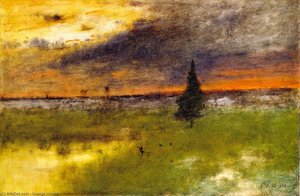
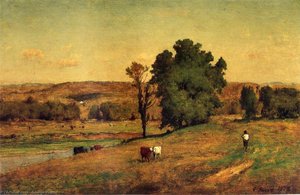
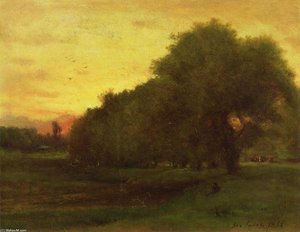
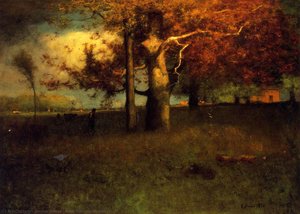
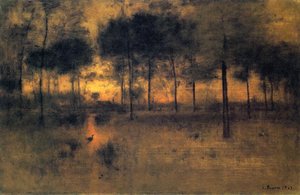
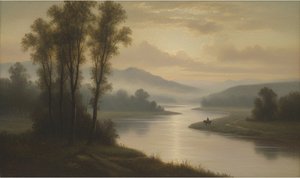
To gaze upon George Inness’s "The Lonely Pine" is to step into a moment suspended in time—a breath held between dawn and dusk. This exquisite oil on canvas, painted in 1893, transcends mere landscape depiction; it is an immersion into profound tranquility. The composition centers around a solitary pine tree, standing as a steadfast sentinel against a sky washed in the most breathtaking hues of warm orange. This singular focal point draws the eye immediately, suggesting resilience and quiet endurance amidst the vastness of nature. It speaks to that universal human yearning for grounding beauty.
Tonalism and the Spirit of Place
George Inness’s artistic signature is deeply rooted in Tonalism, a style that prioritized mood and atmosphere over sharp detail or dramatic narrative. His work carries the contemplative weight of the Barbizon school's devotion to nature, yet it possesses a distinctly American spiritual resonance. Here, the interplay between the deep greens of the scattered foliage, the mysterious body of water glimpsed below, and that enveloping orange sky creates a palpable sense of *ennui*—not sadness, but a beautiful, thoughtful melancholy. The technique itself, executed in rich oil on canvas, allows the light to seem almost tangible, wrapping the entire scene in a luminous embrace.
Symbolism Woven into the Landscape
The symbolism within "The Lonely Pine" is as deep as its subject matter suggests. The lone pine often serves as an archetype—a symbol of steadfastness, longevity, and enduring spirit. Standing apart from the surrounding, more clustered trees, it embodies introspection; it invites the viewer to pause their own hurried thoughts and consider what it means to stand alone yet remain perfectly rooted. Coupled with the warm, almost spiritual glow of the sky, the painting suggests a moment of profound personal revelation found within nature’s quiet grandeur.
Bringing Atmosphere Home
For those who seek to infuse their living space or office with an aura of contemplative calm, a reproduction of this masterpiece is nothing short of transformative. The rich texture inherent in the oil paint ensures that even a reproduction retains the depth and vibrancy of Inness’s original vision. It functions not merely as decoration, but as a visual anchor—a daily reminder to slow down, to observe the subtle shifts in light, and to find the enduring beauty in solitude. Owning this piece is acquiring a portal to a moment of perfect, serene contemplation.
Related Artworks


Artist Biography
George Inness (1825–1894): The Quiet Observer of Nature’s Soul
George Inness, born in Newburgh, New York, in 1825, stands as a pivotal figure in American Impressionism—a movement that sought to capture fleeting moments of beauty and emotion through luminous color palettes and loose brushstrokes. Unlike the grand narratives championed by the Hudson River School, Inness’s artistic vision prioritized introspection and spiritual contemplation, reflecting his profound engagement with philosophical ideas. This dedication resulted in landscapes imbued with a palpable serenity, portraying rural scenes and animal life with remarkable sensitivity to light and atmosphere. His legacy continues to inspire artists today who strive for similar expressive depth.- Early Life & Education: Inness’s formative years were marked by exposure to Transcendentalist thinkers like Ralph Waldo Emerson and Henry David Thoreau, whose emphasis on intuition and connection with the natural world profoundly shaped his artistic sensibilities. He pursued formal training at Yale University before embarking on a self-directed study of art in Paris during the mid-1850s—a crucial period for absorbing Impressionistic techniques.
- Parisian Influences & Artistic Development: In Paris, Inness immersed himself in the burgeoning Impressionist movement, studying under Gustave Courbet and Jean-François Millet. These encounters solidified his commitment to capturing immediate visual sensations rather than meticulously recreating reality. He experimented with plein air painting—working outdoors directly from nature—developing a distinctive style characterized by subtle gradations of color and textured brushwork.
- Notable Landscapes & Paintings: Inness’s oeuvre comprises numerous iconic landscapes that exemplify the movement's aesthetic principles. Works such as “The Dark Side of Twilight” (1869) and “Winter Landscape” (1873) are celebrated for their masterful depiction of atmospheric conditions—particularly mist and snow—and their ability to evoke a sense of profound stillness. His portraits, too, reveal an artist’s keen observation of human psychology.
- Symbolism & Spiritual Vision: Beyond mere visual representation, Inness's paintings convey deeper symbolic meanings rooted in his philosophical convictions. Recurring motifs—such as trees and animals—represent resilience, harmony, and the interconnectedness of all living things. His canvases are not simply landscapes; they are meditations on the sublime beauty of nature and its capacity to inspire spiritual awareness.
- Legacy & Historical Significance: George Inness’s contribution to American art is undeniable. He championed a humanist aesthetic that prioritized emotional resonance over technical virtuosity—a stance that distinguished him from his contemporaries and cemented his place as one of the foremost Impressionist painters of his time. His influence extends beyond painting, inspiring subsequent generations of artists to explore themes of contemplation and connection with the natural world.

george innes
1825 - 1894 , United States of America
Quick Facts
- Artistic Movement Or Style: American Impressionism
- Artists Or Movements Influenced By This Artist: ['Impressionism']
- Artists Who Influenced This Artist: ['Hudson River School']
- Date Of Birth: 1825
- Full Name: George Inness
- Nationality: American
- Notable Artworks:
- The Black Swan
- A Bit of Roman Aqueduct
- Summer Days
- Place Of Birth: Newburgh, New York, United States
Related Articles
George Inness: Transcendental Landscapes & the American Search for Spiritual Harmony
Explore the profound landscapes of George Inness, a leading American artist-philosopher. Discover his spiritual approach to painting, influences, and lasting legacy with AllPaintingsStore.
George Elbert Burr: A Pioneer of American Tonalism & Evocative Landscape Painting
Explore the captivating landscapes of George Elbert Burr, a pioneer of American Tonalism. Discover his masterful etchings, drypoints & watercolors – and learn about collecting this influential artist's work.

Thomas Wilmer Dewing: Atmospheric Landscapes & the American Tonalist Vision
Explore the captivating world of Thomas Wilmer Dewing, a leading figure in American Tonalism. Discover his evocative paintings, artistic influences, and legacy with AllPaintingsStore.
Thomas George Webster: Navigating Genre Boundaries & American Identity in 19th-Century Landscape Painting
Explore the captivating genre scenes of Thomas George Webster, a Victorian painter bridging British traditions with American themes. Discover his style, influences & legacy in 19th-century art history.

Atmospheric Visions: Exploring Tonalism in American Painting
Explore the captivating world of American Tonalism! Discover its history, key artists like Whistler & Inness, techniques, and lasting influence on art. Expert insights for collectors & enthusiasts.