Preview
 Send
Send Share
Share
 Details
 Guide
Guide

 Download
 Similars
 X-Ray
X-Ray Diaporama
 Q&A
Q&A Stats
StatsSpring


 Read More
The artwork displayed on this page is protected by copyright law, which means we cannot legally create or sell an identical reproduction. This protection is enforced under international agreements such as the Berne Convention and by national laws, including those outlined by the U.S. Copyright Law - Title 17.
This method fully complies with copyright regulations because it does not involve copying or duplicating the protected artwork. Instead, it is a creative reinterpretation - a new painting that is influenced by the original but not identical to it.
Giclée / Art Print
Museum-quality giclée or canvas print with fast production and flexible finish options. ( Buy Hand Made Painting Switch to Digital Image)




P118B $10

P118H $10

P118W $10

P438Z $10

P508JH $12

P508YH $12

P805H $10

P805Z $10

P919BZ $10

P919G $10

P919XJ $10

P959ZH $10

P968JZ $12

W106C $8

W218G $10

W218JH $8

W218Y $10

W307PJ $10

W316G $10

W316PJ $8

W316Y $10

W398PJ $8

W4111J $10

W500HY $15

W500JH $15

W692G $12

W849H $8

W940BG $15

W953PJ $8




Pick from our preset sizes that match the artwork's original proportions.

Type the width and the height you need, to fit your frame or your wall. A print can only be cut, never made bigger than the picture, so a size with a different shape loses a part of the image. We send you a digital mockup to approve before we print anything. The picture shown on this page does not show the real cut — only the mockup does.
Worldwide Delivery () in 2 weeks instead of standard 4/5 weeks. (13 November)

Free Worldwide Express Shipping

High-Quality Linen Canvas

Full Shipping Insurance

Customs Tax Refund Guarantee

True Color Matching Guarantee

100-Day Return Policy (Defects Only)

100% Money-Back Guarantee

Bulk Discount Offer
 Glass option is only available in size under 110 CM

Spring
Giclée / Art Print
Reproduction Size
-


Total Price
$ 65
A Poetic Encounter with Solitude
In this evocative painting, we find ourselves immersed in a moment of profound atmospheric stillness. The composition centers on a solitary figure, a man seen from behind, standing amidst the gentle descent of rain. Clad in the formal attire of a suit and tie, his posture suggests a quiet introspection, as if he is momentarily suspended between the world around him and his own internal reflections. This sense of isolation is heightened by the soft, painterly rendering of the elements, where the texture of the falling rain blurs the boundaries between the subject and his environment. The presence of other figures in the background, though less distinct, creates a subtle tension—a reminder of the bustling social world that continues to move, even as our protagonist finds himself anchored in a private, melancholic sanctuary.
The scene is further enriched by a curious collection of objects that punctuate the landscape like fragments of a dream. A clock rests on the left, its presence hinting at the relentless passage of time, while a vase and scattered bowls introduce a domestic, almost still-life quality to the outdoor setting. These elements—the cup tucked into the corner, the rhythmic placement of vessels—transform a simple rainy day into a complex narrative about the objects we inhabit and the memories they hold. For the discerning collector or interior designer, this piece offers more than mere decoration; it provides a window into a contemplative state of being, making it an ideal centerpiece for spaces dedicated to thought, peace, and quiet elegance.
The Intersection of Symbolism and Atmosphere
Beyond its immediate visual charm, the artwork functions as a sophisticated commentary on visibility and perception. The technique employed here leans into a soft-focus realism, where light and shadow dance across the surfaces of the rain-slicked objects, creating a luminous yet somber mood. By placing familiar, everyday items—a cup, a bowl, a clock—within this atmospheric context, the artist invites us to reconsider the sanctity of the mundane. There is a profound emotional weight in the way the man’s back is turned to the viewer; it creates an invitation to empathize with his unseen experience, drawing the observer into a shared moment of vulnerability and strength.
This painting serves as a masterful bridge between classical storytelling and modern emotional abstraction. It captures the essence of a fleeting moment, freezing the ephemeral nature of rain and solitude into a permanent, tactile experience. For those looking to infuse a room with depth and narrative complexity, this reproduction offers an unparalleled opportunity to engage with art that speaks to the universal human experience of finding oneself within the crowd, yet remaining beautifully, resolutely alone.
Questions & Answers
Is "Spring" typical of what Jasper Johns usually created?
Jasper Johns's recurring themes include iconography, symbolism, americana, identity, reflection; "Spring" focuses on rain, suit, clock, vase, bowls, man, landscape.
Where is "Spring" suggested to be displayed, considering its palette?
The neutrals colors of "Spring" by Jasper Johns match its recommended space: a living room.
How can I view "Spring" by Jasper Johns as a slideshow?
"Spring" by Jasper Johns can be viewed as a slideshow on the artwork's Diaporama page.
Related Artworks


Artist Biography
Early Life, Family and Training
Jasper Johns was born on May 15, 1930, in Augusta, Georgia. His parents' marriage ended in divorce when he was very young, leading him to be raised in South Carolina. He spent much of his childhood in Allendale, South Carolina, living with his paternal grandparents. Later, he spent time with his mother and stepfather in Columbia, and eventually lived with his Aunt Gladys on Lake Murray. He began drawing at the age of three. By the time he reached high school, he was already focused on his craft, eventually graduating as the valedictorian of the class of 1947 from Edmunds High School in Sumter, South Carolina.
His formal training began in the South. He attended the University of South Carolina at Columbia for three semesters. After leaving the university, he moved to New York City in 1949. There, he enrolled at the Parsons School of Design to continue his studies. He worked various odd jobs during these formative years, including a stint as a bookstore clerk, before his path was interrupted by the draft.
Military Service and Return to New York
The trajectory of his early years was interrupted in 1951 when he was drafted into the United States Army during the Korean War. This period of service took him away from the art schools of the East Coast and placed him in two very different settings. He spent time stationed at Fort Jackson in South Carolina before being sent to Sendai, Japan. These years of military duty provided a distance from the burgeoning art scene he had begun to navigate in New York.
By the summer of 1953, he returned to New York City. The city was a place of transition, and he found work at Marboro Books. This period of employment allowed him to settle back into the urban environment, moving through the city's social and artistic layers. It was during these post-service months that he began to form the connections that would define his later practice, working alongside others in the city's lofts and studios.
The Emergence of a New Visual Language
By 1954, a shift had occurred in the way objects were handled on the canvas. Instead of the spontaneous, gestural marks that defined the era, there was a move toward things the mind already knows. This meant using symbols that required no explanation: flags, maps, targets, letters, and numbers. These were not illustrations of specific events, but rather recognizable forms used to explore how we perceive meaning. The work became a way to look at the act of seeing itself, using the familiar to question the nature of representation.
This approach helped establish him as a central figure in the development of American postwar art. His first solo exhibition took place in 1958 at the Leo Castelli Gallery, where the presence of these common symbols first met a wider audience. The paintings did not try to escape the world through abstraction; they brought the world into the studio through these quiet, repetitive motifs. By stripping away the need for narrative, the focus shifted to the surface and the way a symbol functions as a visual code.
Technique and Artistic Style
The surface of a Johns painting often feels heavy and built up. He frequently used encaustic, a process where pigment is mixed with hot wax to create a thick, textured layer. This method allows for a physical depth that sits on the canvas, sometimes incorporating collage and newsprint directly into the wax. These layers do not suggest a quick, spontaneous gesture. Instead, the work shows a sense of conscious control. Every mark and shape seems placed with a specific intent, moving away from the messy, emotional drips seen in other mid-century styles. He preferred a more calculated approach to how an image is constructed.
Beyond the canvas, his hand shows in many different ways. He moved between the heavy texture of encaustic and the precise, sharp lines of printmaking. His practice included lithography, screenprint, etching, and aquatint. These methods allowed him to repeat certain shapes and symbols with varied textures. He often used the same motifs—numbers, letters, or maps—to see how they changed when the method of application shifted. The work is about the way a viewer recognizes a shape and how that recognition changes when the surface is layered or fragmented.
- Target (1958)
- White Flag (1955)
- Colored alphabet (about 1959)
- False Start (1959)
- Perilous Night (1982)
Key Works and Iconic Imagery
The work often centers on things the mind already knows. In the mid-1950s, the painting Flag (1954–55) used a collage of the Stars and Stripes, layering newspaper with pigment. This approach turned a familiar symbol into a textured surface of wax and paper. The imagery moved from these large, flat symbols toward more concentrated forms. The target series followed, using the bullseye to question how a viewer perceives a simple shape. One such piece, Target with Four Faces (1958), placed faces within the red field, creating a sense of unease through their repetitive, expressionless arrangement.
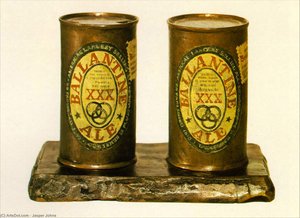
The focus on recognizable objects continued into the 1960s. The 1961 work Map used fragmented depictions of the United States to look at geography and identity. This period also saw a shift toward three-dimensional forms that mimicked everyday items. In 1960, the Painted Bronze (Beer Cans) series was produced. These sculptures were cast in bronze but painted to look exactly like the common objects they represented, blurring the line between a real object and a painted one.
- White Flag (1955)
- Three Flags (1958)
- False Start (1959)
- Colored Alphabet (about 1959)
Circle of Influential Associates
In the lofts of Manhattan, the air was thick with shared ideas and the quiet friction of proximity. Johns lived in adjacent apartments to Robert Rauschenberg, a relationship that was both romantic and artistic until 1961. They spent their days designing window displays for stores like Tiffany and Bonwit Teller, working side by side to transform the mundane into something else entirely. This closeness meant their work was constantly in conversation, a continuous exchange of thoughts and visual experiments that helped define a new direction for American art.
The circle extended into the realms of sound and movement. Johns was close friends with the composer John Cage and the choreographer Merce Cunningham. These connections brought a different kind of rhythm to his thinking, one rooted in the avant-garde. He moved through a landscape where the boundaries between different disciplines were porous, influenced by the way Cage and Cunningham approached structure and chance. Even the ideas of Marcel Duchamp lingered in the background, providing a framework for questioning the very nature of what an object could represent when placed within a frame.
Legacy and Enduring Influence
The shift from the spontaneous, gestural marks of Abstract Expressionism toward the recognizable imagery of Pop Art happened in large part through his hands. By taking things the mind already knows—flags, targets, and numbers—and treating them as subjects for investigation, he changed how artists approached the canvas. This movement toward the everyday paved the way for the work of Andy Warhol and Roy Lichtenstein, who would later build upon these ideas of mass culture and commodity.
His presence in the art world has been marked by significant recognition. He was awarded the Golden Lion at the Venice Biennale in 1988. Later, in 2011, he received the Presidential Medal of Freedom. These honors reflect a career spent questioning the nature of representation and the way symbols function in a changing society.
- Flag (1954–55)
- Target (1958)
- Map (1961)
- Perilous Night (1982)
Where to See the Works Today
To see his paintings and sculptures in person, one might travel to New York City. The Museum of Modern Art holds several of his pieces, while the Whitney Museum of American Art and the Metropolitan Museum of Art also keep his work in their collections. These institutions house various stages of his development, from his early experiments with encaustic to his later explorations of the artist's studio.
His presence extends beyond the United States. In London, the Tate Modern holds works that reflect his long-standing interest in how we perceive familiar symbols. Seeing these objects in such different settings allows for a closer look at how his use of texture and repetition changes under different lights.
- White Flag, 1955
- Target, 1958
- Map, 1961
- Perilous Night, 1982
- Dancers on a Plane, about 1964
Jasper Johns
1930 - , United States
Quick Facts
- Artists Or Movements Influenced By This Artist:
- Pop Art
- Andy Warhol
- Roy Lichtenstein
- Artists Who Influenced This Artist: ['Marcel Duchamp']
- Full Name: Jasper Johns
- Nationality: American
- Notable Artworks:
- Flag
- Target
- Map
- False Start
- White Flag
- Place Of Birth: Augusta, United States of America
- Date Of Birth: 1930
Related Articles

Lyrical Abstraction: The Emotional Power of Color and Form in Modern Art History
Explore the profound emotional depth of Lyrical Abstraction. Discover how masters like Raymond Parker used color and form to bridge Impressionism and Abstract Expressionism. Learn about this pivotal movement through our expert-led art history guide.

Beyond the Lines: Mastering the High-Impact World of Contemporary Abstraction
Master the high-impact world of contemporary abstraction. Discover how bold colors, textures, and modern movements like Abstract Expressionism can transform your space with premium, high-energy art curated for the design-conscious professional.
John Singer Sargent's 25 Masterpieces: Portraits & Beyond | AllPaintingsStore
Explore 25 iconic John Singer Sargent paintings – from dazzling portraits to Impressionist landscapes. Discover the stories behind Madame X, El Jaleo & more! Find museum-quality art reproductions and elevate your home decor with AllPaintingsStore.com.

Abstract Expressionism's 10 Defining Masterpieces |
Explore 10 defining Abstract Expressionism masterpieces by Pollock, Rothko & de Kooning. Discover the stories behind these iconic paintings and find museum-quality art reproductions to elevate your home decor on .

Masterpieces of Nature: The Top 25 John Constable Artworks
Explore John Constable's iconic landscapes and Romantic masterpieces. Discover the full collection online at AllPaintingsStore.com.