- Home

- Oil Painting Reproduction
- Paul Nash
- Telecommunications

 Buy print
 Send
Send Share
Share
 Details

 Download
 Similars
 X-Ray
X-Ray Diaporama
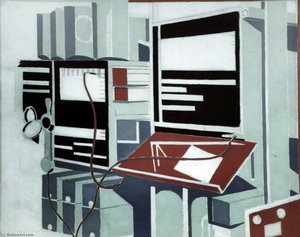
Telecommunications
 Oil On Canvas
- WallArt
- Cubism
 1934
1934 52.0 x 65.0 cm
 Walker Art Gallery
 Read More
Hand Made Oil Reproduction
Hand-painted oil on canvas in your size and frame, made to order by our artists.




P118B $10

P118H $10

P118W $10

P438Z $10

P508JH $12

P508YH $12

P805H $10

P805Z $10

P919BZ $10

P919G $10

P919XJ $10

P959ZH $10

P968JZ $12

W106C $8

W218G $10

W218JH $8

W218Y $10

W307PJ $10

W316G $10

W316PJ $8

W316Y $10

W398PJ $8

W4111J $10

W500HY $15

W500JH $15

W692G $12

W849H $8

W940BG $15

W953PJ $8




Pick from our preset sizes that match the artwork's original proportions.

You may enter your own dimensions to fit a specific frame or space. If your selected size does not match the original image's proportions, we will either crop the artwork or extend the painting with additional hand-painted elements. A digital mockup will be sent for your approval before production begins.
Please note that the on-screen preview does not reflect the actual cropping or extension. Only the mockup will accurately show the final composition.
While custom sizes are available, we recommend selecting a dimension from the predefined list to preserve the original proportions.
After order, AllPaintingsStore.com team will email client for instructions and provide a mockup preview
Worldwide Delivery () in 3/4 weeks instead of standard 5 weeks. (16 July). No compromise on quality.

Free Worldwide Express Shipping

High-Quality Linen Canvas

Full Shipping Insurance

Customs Tax Refund Guarantee

True Color Matching Guarantee

60-Day Return Policy (Defects Only)

100% Money-Back Guarantee

Bulk Discount Offer
 Glass option is only available in size under 110 CM

Telecommunications
Reproduction Medium
Reproduction Size
-


Total Price
-
Artwork Description
A Static Symphony: Unpacking Paul Nash's "Telecommunications"
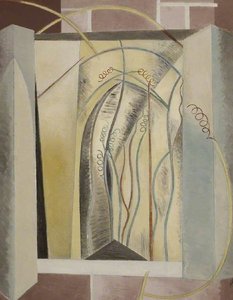
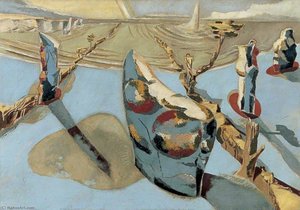
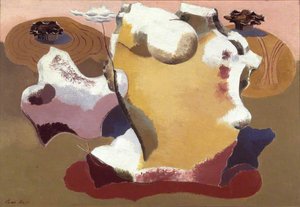
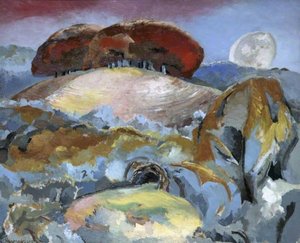
Paul Nash’s 1934 painting, “Telecommunications,” isn’t merely a still life; it’s a carefully constructed visual argument about the burgeoning anxieties and promises of modernity. Rendered in a restrained palette of greys, blacks, whites, and muted reds – colors that evoke both industrial austerity and a subtle, melancholic beauty – the work immediately draws the viewer into a world where familiar objects are fractured, rearranged, and imbued with an unsettling sense of detachment. It’s a piece that speaks volumes about the era's fascination with technology while simultaneously hinting at its potential to alienate us from nature and ourselves.
The composition itself is deliberately asymmetrical, creating a dynamic tension that mirrors the rapid changes occurring in society during the 1930s. A table dominates the foreground, supporting a bowl, an apple (a potent symbol of temptation and knowledge), and a draped cloth – objects rendered with a Cubist sensibility; their forms are broken down into geometric shapes, overlapping and receding from view as if viewed through a distorted lens. The central element, a towering telecommunications tower, acts as both the focal point and the unsettling anchor of the piece. It’s not depicted realistically but rather as a rigid, almost menacing structure, its sharp angles cutting across the otherwise muted tones.
Cubism Meets Constructivism: A Hybrid Style
Nash's style is a fascinating blend of Cubist and Constructivist influences. The fragmentation of forms, reminiscent of Picasso and Braque, is combined with a deliberate emphasis on geometric shapes – rectangles, triangles, and lines – echoing the principles of Constructivism, which sought to reduce art to its essential elements. This fusion creates an image that feels both familiar and strangely alienating, reflecting the anxieties of a world grappling with rapid industrialization and technological advancement. The flattened perspective, characteristic of Cubism, further contributes to this sense of detachment, as if the objects are suspended in a timeless void.
The technique employed is remarkably controlled. Nash utilizes a brushstroke-based approach, creating a surface that appears smooth and almost graphic. However, closer inspection reveals subtle variations in texture and tone, suggesting a deliberate layering of paint – a testament to his skill as a painter. The limited color palette reinforces the painting’s overall mood, contributing to its sense of quiet intensity and underlying unease. The choice of materials—likely oil paints on canvas or board—adds to the work's durability and timeless quality.
Echoes of Blake and the British Landscape
To understand Nash’s artistic vision fully, it’s crucial to consider his early influences. Like William Blake before him, Nash was deeply fascinated by mythology and folklore, often incorporating symbolic elements into his work. His childhood spent in Buckinghamshire instilled a profound love for the English landscape, particularly ancient burial mounds and Iron Age hill forts – motifs that frequently appear in his paintings. “Telecommunications” can be interpreted as a meditation on this relationship between the natural world and the encroaching forces of modernity. The tower, a symbol of technological progress, stands in stark contrast to the implied tranquility of the surrounding landscape, suggesting a potential loss or disruption of connection.
A Timeless Reflection: Reproduction Possibilities
Reproductions of “Telecommunications” offer a remarkable opportunity to bring this evocative artwork into your home or office. AllPaintingsStore’s high-quality reproductions capture the painting's nuanced details and atmospheric mood with exceptional fidelity. Whether you choose a canvas print, a framed giclée, or a metal print, you can experience the power of Nash’s vision firsthand. This piece is more than just decoration; it’s a conversation starter – a visual reminder of our complex relationship with technology and the enduring beauty of the natural world. Consider this artwork as an investment in both artistic appreciation and a thoughtful reflection on the modern condition.
Related Artworks


Artist Biography
Early Life and Influences
- Born: Kensington, United Kingdom (1889)
- Died: 1946
- Paul Nash was born on May 11, 1889, in London. His father, William Harry Nash, was a barrister, and his mother, Caroline Maude, displayed signs of mental illness from an early age. The family moved to Iver Heath, Buckinghamshire, when Paul was young, a move intended to benefit his mother's health.
- Education: He attended the Parsons School of Art and later the Slade School of Fine Art. While proficient in landscape painting, he struggled with figure drawing.
- Early Influences: Nash was heavily influenced by William Blake and J.M.W. Turner, evident in his early works. He also drew inspiration from landscapes featuring ancient historical elements like burial mounds and Iron Age hill forts.
Artistic Style and Development
- Style: Paul Nash's style blended modernism with traditional techniques. He utilized bold colors, geometric shapes, and abstract forms, distinguishing him from contemporaries.
- Surrealist Leanings: While not strictly a Surrealist, Nash was influenced by the movement, particularly after seeing a Giorgio de Chirico exhibition in 1928. His work incorporated symbolic landscapes with everyday objects.
- War Art: During World War I and II, Nash served as an official war artist. His depictions of battlefields were notable for their haunting beauty and exploration of the impact of conflict on the landscape. Notable works include "The Menin Road."
- "Aerial Creatures": A series produced during WWII featuring anthropomorphic depictions of aircraft crashed in landscapes, demonstrating his evolving style and symbolism.
Major Achievements and Recognition
- Pioneer of British Modernism: Nash played a crucial role in shaping British modern art, bridging traditional landscape painting with modernist aesthetics.
- War Art Legacy: His wartime paintings are considered iconic representations of the conflict's impact on both soldiers and the environment.
- Unit One Group: He co-founded Unit One in 1933 alongside Ben Nicholson and Barbara Hepworth, a significant group within the British art scene.
- Writer and Designer: Beyond painting, Nash was also a respected writer on art and designed applied arts such as stage scenery, fabrics, and posters.
Influences and Legacy
- Influence on Subsequent Artists: Nash's unique style and use of color influenced generations of artists who followed.
- Connection to Romanticism: His work is often linked to the English Romantic tradition, particularly through his connection to William Blake and J.M.W. Turner.
- Exploration of Man vs. Nature: A recurring theme in Nash's later works was the relationship between humanity and nature, explored through symbolic imagery.
- Continued Relevance: His paintings continue to be celebrated for their beauty, symbolism, and historical significance, remaining relevant to contemporary audiences.
Exhibitions and Collections
- Ruskin Gallery: Nash's work has been exhibited at the Ruskin Gallery in the United Kingdom.
- Tate Britain: His pieces can be found within the Tate Britain’s collection.
- Imperial War Museum: Several of his war art pieces are housed in the Imperial War Museum.
- York Art Gallery: His work is also part of the York Art Gallery's collection.
- Government Art Collection: A selection of Nash’s artworks are displayed within the Government Art Collection.

Paul Nash
1889 - 1946 , United Kingdom
Quick Facts
- Artistic Movement Or Style: Surrealism, Modernism
- Artists Or Movements Influenced By This Artist: ['Modern artists']
- Artists Who Influenced This Artist:
- William Blake
- J.M.W. Turner
- Wolfgang Lettl
- Date Of Birth: May 11, 1889
- Date Of Death: July 11, 1946
- Full Name: Paul Nash
- Nationality: British
- Notable Artworks: ['The Menin Road']
- Place Of Birth: Kensington, United Kingdom
Related Articles

Deconstructing Reality: A Comprehensive Exploration of Cubist Still Life
Explore the revolutionary world of Cubist Still Life with AllPaintingsStore. Discover Picasso & Braque's groundbreaking techniques, its philosophical roots, and lasting impact on modern art. Expert insights for collectors.

Culinary Echoes: Commissioning Hyperrealistic Still Life Paintings as Personal Legacies for the Modern Home
Commission a breathtaking hyperrealistic still life painting with AllPaintingsStore. Preserve cherished culinary moments as timeless heirlooms. Museum-quality craftsmanship, personalized service & a lasting legacy for your home.
The Bountiful Still Life: Symbolism & Artistic Representation of Fruit Across Art History
Explore the rich history of still life painting & the symbolism of fruit across art movements. Discover masterpieces from Caravaggio to Cézanne with AllPaintingsStore – expert guidance & museum-quality reproductions.

The Enduring Appeal of Still Life: A Historical & Contemporary Exploration
Explore the rich history & symbolism of still life painting with AllPaintingsStore. Discover masterpieces from the Dutch Golden Age, learn about vanitas art, and find expert guidance for collecting timeless artworks.

From Classical Still Life to Contemporary Abstraction: Elevating Villa Entertaining Spaces Through Artful Reproduction
Explore the history of still life painting & discover how artful reproductions elevate villa entertaining spaces. Expert guidance, museum-quality prints & custom artwork at AllPaintingsStore.com.