- Home

- Oil Painting Reproduction
- Paul Nash
- Eclipse of the Sunflower

 Buy print
 Send
Send Share
Share
 Details

 Download
 Similars
 X-Ray
X-Ray Diaporama
Eclipse of the Sunflower
 Oil On Canvas
- WallArt
- Surrealism
 1945
1945 71.0 x 91.0 cm
 British Council Collection
 Read More
Hand Made Oil Reproduction
Hand-painted oil on canvas in your size and frame, made to order by our artists.




P118B $10

P118H $10

P118W $10

P438Z $10

P508JH $12

P508YH $12

P805H $10

P805Z $10

P919BZ $10

P919G $10

P919XJ $10

P959ZH $10

P968JZ $12

W106C $8

W218G $10

W218JH $8

W218Y $10

W307PJ $10

W316G $10

W316PJ $8

W316Y $10

W398PJ $8

W4111J $10

W500HY $15

W500JH $15

W692G $12

W849H $8

W940BG $15

W953PJ $8




Pick from our preset sizes that match the artwork's original proportions.

You may enter your own dimensions to fit a specific frame or space. If your selected size does not match the original image's proportions, we will either crop the artwork or extend the painting with additional hand-painted elements. A digital mockup will be sent for your approval before production begins.
Please note that the on-screen preview does not reflect the actual cropping or extension. Only the mockup will accurately show the final composition.
While custom sizes are available, we recommend selecting a dimension from the predefined list to preserve the original proportions.
After order, AllPaintingsStore.com team will email client for instructions and provide a mockup preview
Worldwide Delivery () in 3/4 weeks instead of standard 5 weeks. (16 July). No compromise on quality.

Free Worldwide Express Shipping

High-Quality Linen Canvas

Full Shipping Insurance

Customs Tax Refund Guarantee

True Color Matching Guarantee

60-Day Return Policy (Defects Only)

100% Money-Back Guarantee

Bulk Discount Offer
 Glass option is only available in size under 110 CM

Eclipse of the Sunflower
Reproduction Medium
Reproduction Size
-


Total Price
-
Artwork Description
Paul Nash’s Eclipse of the Sunflower: A Meditation on Decay and Renewal
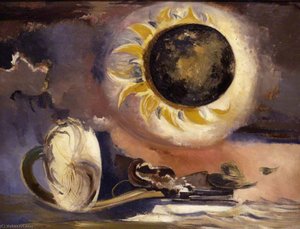
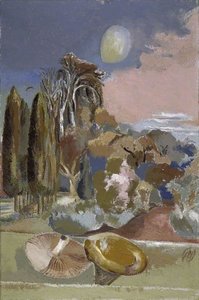
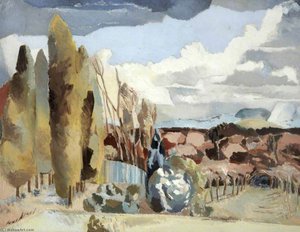
Paul Nash (1889–1946) stands as one of Britain's foremost landscape artists of the first half of the twentieth century, a figure whose distinctive style blended modernist experimentation with a profound connection to the natural world. His oeuvre is marked by an unsettling beauty—a preoccupation with desolate landscapes and symbolic imagery that speaks to anxieties about loss and transformation. “Eclipse of the Sunflower,” created in 1945 during the twilight years of his life, exemplifies this artistic vision perfectly. This watercolour, housed in the British Council Collection, offers a poignant glimpse into Nash’s final creative explorations and invites contemplation on themes of mortality and resilience.- Subject Matter: The painting depicts a solitary sunflower head against a dark, almost monochrome background. Unlike depictions of vibrant blooms bursting with life, Nash presents a withered flower—a symbol of fading vitality—underscored by the looming presence of an eclipsed sun. This juxtaposition immediately establishes a tension between darkness and light, decay and potential rebirth.
- Style & Technique: Nash’s style is characterized by bold geometric shapes and simplified forms, reflecting influences from Cubism and Surrealism. He eschewed meticulous realism in favor of conveying mood and atmosphere through expressive brushstrokes and tonal variations. The watercolor medium lends itself beautifully to capturing subtle nuances of color and texture, allowing for a delicate rendering of the sunflower’s drooping petals and the shadowed expanse of the sky.
- Historical Context: “Eclipse of the Sunflower” was produced in the immediate aftermath of World War II, a period marked by profound disillusionment and uncertainty. Nash's artistic sensibilities mirrored the anxieties of his time—a recognition that even amidst devastation, nature persists, offering solace and hinting at an inevitable return to equilibrium. The painting’s quiet solemnity reflects the pervasive mood of introspection prevalent in British art during this era.
- Symbolism: The sunflower itself is a rich symbol of resilience and optimism—its tendency to turn its face towards the sun despite unfavorable conditions representing perseverance and hope. However, Nash deliberately portrays it as dying, suggesting that beauty and vitality are inevitably accompanied by vulnerability and eventual decline. The eclipsed sun reinforces this idea, symbolizing not only darkness but also the cessation of outward brilliance, prompting viewers to consider inner reflection and acceptance of impermanence.
- Emotional Impact: “Eclipse of the Sunflower” evokes a palpable sense of melancholy yet simultaneously conveys an underlying affirmation of life’s cyclical nature. The painting's muted palette and understated composition invite contemplation on themes of mortality and regeneration, prompting viewers to confront their own anxieties about loss while appreciating the enduring power of beauty in its most vulnerable form. It is a testament to Nash’s ability to transform observation into profound artistic expression.
Related Artworks




Artist Biography
Early Life and Influences
- Born: Kensington, United Kingdom (1889)
- Died: 1946
- Paul Nash was born on May 11, 1889, in London. His father, William Harry Nash, was a barrister, and his mother, Caroline Maude, displayed signs of mental illness from an early age. The family moved to Iver Heath, Buckinghamshire, when Paul was young, a move intended to benefit his mother's health.
- Education: He attended the Parsons School of Art and later the Slade School of Fine Art. While proficient in landscape painting, he struggled with figure drawing.
- Early Influences: Nash was heavily influenced by William Blake and J.M.W. Turner, evident in his early works. He also drew inspiration from landscapes featuring ancient historical elements like burial mounds and Iron Age hill forts.
Artistic Style and Development
- Style: Paul Nash's style blended modernism with traditional techniques. He utilized bold colors, geometric shapes, and abstract forms, distinguishing him from contemporaries.
- Surrealist Leanings: While not strictly a Surrealist, Nash was influenced by the movement, particularly after seeing a Giorgio de Chirico exhibition in 1928. His work incorporated symbolic landscapes with everyday objects.
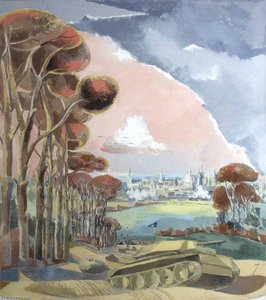
- War Art: During World War I and II, Nash served as an official war artist. His depictions of battlefields were notable for their haunting beauty and exploration of the impact of conflict on the landscape. Notable works include "The Menin Road."
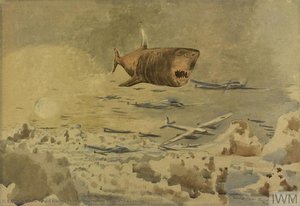
- "Aerial Creatures": A series produced during WWII featuring anthropomorphic depictions of aircraft crashed in landscapes, demonstrating his evolving style and symbolism.
Major Achievements and Recognition
- Pioneer of British Modernism: Nash played a crucial role in shaping British modern art, bridging traditional landscape painting with modernist aesthetics.
- War Art Legacy: His wartime paintings are considered iconic representations of the conflict's impact on both soldiers and the environment.
- Unit One Group: He co-founded Unit One in 1933 alongside Ben Nicholson and Barbara Hepworth, a significant group within the British art scene.
- Writer and Designer: Beyond painting, Nash was also a respected writer on art and designed applied arts such as stage scenery, fabrics, and posters.
Influences and Legacy
- Influence on Subsequent Artists: Nash's unique style and use of color influenced generations of artists who followed.
- Connection to Romanticism: His work is often linked to the English Romantic tradition, particularly through his connection to William Blake and J.M.W. Turner.
- Exploration of Man vs. Nature: A recurring theme in Nash's later works was the relationship between humanity and nature, explored through symbolic imagery.
- Continued Relevance: His paintings continue to be celebrated for their beauty, symbolism, and historical significance, remaining relevant to contemporary audiences.
Exhibitions and Collections
- Ruskin Gallery: Nash's work has been exhibited at the Ruskin Gallery in the United Kingdom.
- Tate Britain: His pieces can be found within the Tate Britain’s collection.
- Imperial War Museum: Several of his war art pieces are housed in the Imperial War Museum.
- York Art Gallery: His work is also part of the York Art Gallery's collection.
- Government Art Collection: A selection of Nash’s artworks are displayed within the Government Art Collection.

Paul Nash
1889 - 1946 , United Kingdom
Quick Facts
- Artistic Movement Or Style: Surrealism, Modernism
- Artists Or Movements Influenced By This Artist: ['Modern artists']
- Artists Who Influenced This Artist:
- William Blake
- J.M.W. Turner
- Wolfgang Lettl
- Date Of Birth: May 11, 1889
- Date Of Death: July 11, 1946
- Full Name: Paul Nash
- Nationality: British
- Notable Artworks: ['The Menin Road']
- Place Of Birth: Kensington, United Kingdom
Related Articles

George Barret the Elder: Pioneering British Pastoral Painting & Landscape's Rise
Explore the life & art of George Barret Sr., a pioneer of British pastoral painting. Discover his influence on Romantic landscape art, patronage, and collecting tips from AllPaintingsStore.

Brian Hatton: A Study in Early 20th-Century British Landscape Painting & Rural Identity
Explore the captivating landscapes & portraits of Brian Hatton (1887-1916), a promising British artist lost too soon. Discover his unique style, Herefordshire roots, and lasting legacy in early 20th-century art.

Edward Seago: A Life Painted in Light – Nostalgia & the British Landscape Tradition
Explore the life & art of Edward Seago, a celebrated British Impressionist painter known for evocative landscapes & seascapes. Discover his captivating works and find high-quality reproductions at AllPaintingsStore.

Paul Nash: Modernism, Myth & the British Landscape – A Visionary Artist
Explore the evocative landscapes & poignant war art of Paul Nash (1889-1946), a key figure in British Modernism. Discover his unique style and lasting impact on art history with AllPaintingsStore.

John Frederick Lewis: Orientalism, Detail & Genre Painting in 19th-Century British Art
Explore the captivating Orientalist paintings of John Frederick Lewis! Discover his mastery of detail, genre scenes & influence on 19th-century British art. Learn about his life, techniques & legacy at AllPaintingsStore.