Money-Back Guarantee · 100 days Free Worldwide Delivery
449,564artworks 30,613artists 4,660museums 32languages
Catalogue entry

Composition no. II

1913. Acrylic On Canvas, 88.0 x 115.0 cm. Kröller-Müller Museum.

Fig. 1. Piet Mondrian, Composition no. II, 1913. Shown as the reproduction you are specifying: , .

§ 1Catalogue data

Dimensions
88.0 x 115.0 cm

§ 2Abstract

Collectible Description

Explore 'Composition no. II' by Piet Mondriaan – a pivotal Neo-Plasticist work featuring geometric abstraction & primary colors. Discover 1913’s grid-like beauty.

Artist Biography

Piet Mondrian pioneered Neoplasticism with works like Broadway Boogie Woogie. Discover the beauty of his geometric abstractions today.

§ 3Commentary

A Dance of Lines and Light: Exploring Piet Mondrian’s *Composition no. II* (1913)

Piet Mondrian's *Composition no. II*, painted in 1913, isn’t merely a painting; it’s an architectural meditation on the very essence of reality. Emerging from his early work depicting the Dutch landscape – particularly the evocative River ’t Gein – this piece represents a pivotal shift in Mondrian’s artistic trajectory, marking his decisive move towards abstraction and the nascent principles of Neo-Plasticism. Initially rooted in the naturalistic traditions of the Hague School, Mondrian began to dismantle representation, stripping away the illusion of depth and embracing instead a rigorously constructed system of lines and colors intended to capture something far more profound: the universal harmony underlying all existence.

The canvas unfolds as a carefully orchestrated grid, dominated by rectangles and squares in varying shades of muted yellow, brown, gray, and pale pink. These aren’t arbitrary hues; Mondrian meticulously selected them from his limited palette – primary colors plus black and white – believing they possessed the purest expressive potential. The crisp, black lines that delineate each shape are not simply boundaries but active participants in the composition, creating a dynamic tension between form and space. Notice how these lines don't converge or recede; instead, they intersect and overlap, generating a sense of layered depth without resorting to traditional perspective. This deliberate flattening of space reflects Mondrian’s belief that art should transcend the limitations of the physical world and tap into a higher, more spiritual realm.

The Roots in ’t Gein: From Landscape to Abstraction

It's crucial to understand *Composition no. II*'s genesis within Mondrian’s earlier work depicting the River ’t Gein. The initial paintings of this area – particularly those capturing the farmstead nestled amongst the trees – served as a springboard for his radical transformation. He didn’t simply paint what he saw; instead, he distilled the essence of these landscapes—the lines of the riverbank, the verticality of the trees, the horizontal expanse of the water—into their most fundamental components. The reflection in the water, a key element in many of these earlier works, is here reduced to an almost ghostly suggestion, a subtle echo of its former self. This process of reduction mirrors Mondrian’s broader philosophical project: to uncover the underlying structure of reality through simplification and abstraction.

Decoding the Symbolism: Harmony Through Reduction

Mondrian himself articulated his intentions during this period with remarkable clarity: “I construct lines and colour combinations on a flat surface with the aim of depicting the general beauty as consciously as possible.” This statement encapsulates the core of Neo-Plasticism – an aesthetic philosophy rooted in the belief that art should be purely abstract, devoid of representational content. *Composition no. II* embodies this principle perfectly. The geometric forms aren’t meant to evoke specific objects or scenes; rather, they are vehicles for expressing a fundamental order and balance. The black lines act as anchors, providing stability and structure, while the colors contribute to a sense of harmony and resonance. It's a visual representation of a search for universal truth—a belief that through reducing form and color to their most essential elements, one could achieve a profound connection with the underlying order of the cosmos.

A Legacy in Form and Color

Painted in 1913, *Composition no. II* stands as a pivotal work in Mondrian’s development and a cornerstone of modern art. Its influence can be seen in countless subsequent abstract paintings and designs. The painting's enduring appeal lies not only in its formal rigor but also in its emotional resonance. It evokes a sense of calm contemplation, inviting the viewer to engage with the underlying structure of reality—a structure that Mondrian believed was accessible through the disciplined application of line and color. Today, reproductions of *Composition no. II* offer a unique opportunity to experience this profound vision firsthand, bringing a touch of timeless elegance and intellectual depth to any space.

Questions & Answers

How can I get a digital file of "Composition no. II" by Piet Mondrian?

To get a digital file of "Composition no. II" by Piet Mondrian, order a high-resolution digital image download on its Digital Image page.

At what size is "Composition no. II" recommended to be printed?

A large reproduction is suggested for "Composition no. II" by Piet Mondrian. Size can be adjusted while keeping the proportions.

Which period of Piet Mondrian's career does "Composition no. II" belong to?

Within Piet Mondrian's career, "Composition no. II" falls in the Early Period. The phase helps compare it with the artist's other works.
§ 4The artist

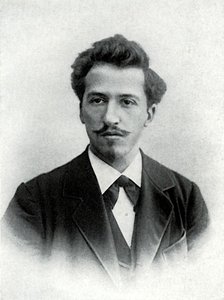
Piet Mondrian

Piet Mondrian

1872 - 1944, Netherlands

Artist Biography

The Architecture of Order

To look at a Mondrian today is to see the blueprint of modern visual culture. We encounter his logic every time we interact with a clean graphic layout or a minimalist building facade. He stripped away the unnecessary until only the essential remained. This was not an act of destruction, but one of extreme distillation. By reducing his vocabulary to straight lines, right angles, and a strict palette of red, blue, and yellow, he removed the distraction of reality to reveal a structural truth.

His early work in the Netherlands followed much more traditional paths. He began with landscapes that captured the windmills and rivers of the Dutch countryside, heavily influenced by the Hague School and Impressionism. Pieces like The Red Mill show an artist focused on naturalistic detail and the soft light of his homeland. However, even in these early years, a drive toward simplification was present. He moved through Pointillism and Fauvism, testing how much color and form could be compressed before the subject disappeared entirely.

The Parisian Shift and Neoplasticism

The move to Paris in 1912 changed everything. Encountering Cubism forced him to deconstruct objects into geometric components. He stopped trying to depict what he saw and began exploring how he saw it. This period was deeply tied to his interest in Theosophy, a mystical philosophy that sought universal principles beneath surface appearances. He believed art could express these hidden truths through pure abstraction.

By 1917, this search resulted in Neoplasticism, or "pure plastic art." Alongside Theo van Doesburg, he co-founded the De Stijl movement to promote a rigid aesthetic of horizontal and vertical lines. The rules were absolute:

  • The use of primary colors: red, blue, and yellow.
  • The use of primary values: black, white, and gray.
  • A focus on right angles and straight lines.

This reduction was a deliberate attempt to manifest spiritual order through visual balance. Works like Composition with Red, Blue and Yellow demonstrate this commitment to geometric purity.

New York and the Final Rhythm

The arrival of World War II forced Mondrian to flee Europe for New York City in 1940. The transition from the organic landscapes of his youth to the rigid grid of Manhattan provided a new, unexpected energy. His late works, such as Broadway Boogie Woogie, show a shift in rhythm. While he maintained his core principles, the lines began to dance with a new, syncopated movement inspired by the city's pulse and jazz music.

His death in 1944 ended a career that had fundamentally altered the trajectory of 20th-century art. He left behind a legacy that moved far beyond the canvas, influencing everything from architecture to fashion, including the famous 1965 collection by Yves Saint Laurent. His work remains a standard for anyone seeking clarity and structural integrity in a chaotic visual age.

§ 5Comparanda

§ 6Questions

Quick Facts

  • Influences: Hague School
  • Movement: Neo-Plasticism
  • Dimensions: 88 x 115 cm
  • Artist: Piet Mondrian
  • Year: 1913

Art Quiz

There is only one correct answer for each question.

Question 1:
Based on the description, what artistic movement is ‘Composition no. II’ primarily associated with?
Question 2:
The description mentions that Mondrian initially painted landscapes. Which artistic style did he experiment with *before* developing his abstract approach?
Question 3:
What is the dominant visual element of ‘Composition no. II’ as described in the image description?
Question 4:
The color palette of ‘Composition no. II’ is characterized by:
Question 5:
According to the description, what was Mondrian’s primary goal in creating works like ‘Composition no. II’?

§ 7Cite this entry

AllPaintingsStore.com, “Piet Mondrian, Composition no. II (1913)”, https://allpaintingsstore.com/en/art/piet-mondrian-composition-no-ii-D8SAS8-en/ArtistReproduction/ (accessed 8 October 2026).

§ 8The reproduction

Hand Made Oil Reproduction

Hand-painted oil on canvas in your size and frame, made to order by our artists. ( Switch to Print Switch to Digital Image)

It is specified on the order sheet in the margin; the present state of that sheet reads as follows.

Composition no. II

Reproduction Medium

Reproduction Size

-

Elite Senior Artist

More detail, finesse, and extra production time

-

Reproduction Frame

-

-

For artworks or reproductions larger than 105 cm (approximately 41 inches) on any side, the frame will be shipped as a kit, disassembled. This method ensures safe delivery and prevents damage during transport.

Professional assembly required - this is not a DIY product.
The kit must be assembled and the canvas stretched by an experienced professional framer, using wood glue (not supplied), a canvas stretching plier and clamps to hold the bars square while the glue dries. Incorrect assembly or uneven canvas tension can permanently damage the artwork and is not covered by our warranty.

  • All solid wood bars are included, precisely cut to size.

  • Assembled with the screws provided, plus wood glue for the corner joints, which is not supplied and must be sourced by your framer.

  • Professional tools are required and not included: a canvas stretching plier (tensioner) and clamps to hold the bars square while the glue dries.

Important:
The corner joints require wood glue, the bars must be held with clamps until the glue is fully dry, and tightening the canvas on the assembled frame requires a canvas stretching plier. None of these are included in the kit. Please arrange an experienced professional framer before ordering this size.

Nameplate

-

-

Protective Varnish

Glossy Varnish (enhances colors, protects against light/moisture)

-

Customize My Artwork

Examples of what can be changed: Replace face with customer photo; Add pet (e.g., replace cat with dog); Include hidden message in background; Change background landscape or elements.

-

Urgent

Worldwide Delivery () in 3/4 weeks instead of standard 5 weeks. (5 November). No compromise on quality.

-

Express Shipping

Worldwide Delivery () in 5 weeks. (12 November).

Included

Total Price

$ 258

Included with every order

  • Free Worldwide Express Shipping
  • High-Quality Linen Canvas
  • Full Shipping Insurance
  • Customs Tax Refund Guarantee
  • True Color Matching Guarantee
  • 100-Day Return Policy (Defects Only)
  • 100% Money-Back Guarantee
  • Bulk Discount Offer
Order sheet