Money-Back Guarantee · 100 days Free Worldwide Delivery
646,446artworks 53,409artists 5,406museums 32languages

Gothic artists at a glance

Famous Gothic Artists — Top 34 List

Duccio di Buoninsegna (1255–1319) is the most famous Gothic artist, best known for Rucellai Madonna and Polyptych No. 28 (The Holy Virgin with the Christ Child and Four Saints). Then Simone Martini, Gentile da Fabriano, Pisanello and Stefan Lochner. The list covers 34 artists born between 1161 and 1465 in 5 countries, from Master Mateo to Jan Baegert.

Method. Scope: artists filed under Gothic in our catalogue. Order: our artist fame ranking. Excluded: artists born after 1955 without a Wikidata identifier. Wikipedia figure: languages with an article, out of our 32.

  1. Rucellai Madonna by Duccio di Buoninsegna1Duccio di Buoninsegna
  2. Maestà (Madonna with Angels and Saints) by Simone Martini2Simone Martini
  3. Adoration of the Magi Altarpiece, left hand predella panel depicting the Nativity by Gentile da Fabriano3Gentile da Fabriano

Key data

Gothic: key data

  • 34Artists
  • 1161–1465Years of birth
  • 5Countries of birth
  • 0Women
  • 1,535Works in our catalogue
Cities with most births
Florence (6), Siena (3), Nijmegen (2), Venice (2)

Ranked list

34 Gothic Artists, ranked with key works

1/ 34

Duccio di Buoninsegna

Italian b. Siena Sienese School, Trecento Gothic Wikipedia 31/32
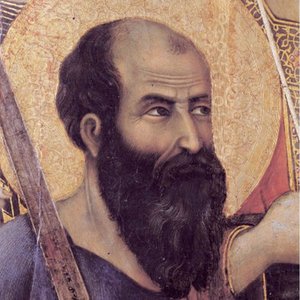
Duccio di Buoninsegna

His work reflects a delicate balance between the celestial splendor of the East and a growing interest in the tangible, human presence. His most monumental achievement remains the Maestà, an expansive altarpiece for Siena Cathedral that was completed by June 1311.

Location The physical remnants of Duccio's career are scattered across several major institutions, offering a way to encounter his specific approach to light and form.

Key works · Top 100 works · Duccio di Buoninsegna reproductions

2/ 34

Simone Martini

Italian b. Siena International Gothic Wikipedia 28/32

Simone Martini

In 1319, he completed the Saint Catherine of Alexandria Polyptych in Pisa. In 1342, he completed the Christ Discovered in the Temple, a painting that can be found in the Walker Art Gallery in Liverpool.

Location In Siena, the Palazzo Pubblico holds the Maestà fresco, a work that has occupied its space since 1315.

Trained Lippo Memmi #9

Key works · Top 100 works · Simone Martini reproductions

3/ 34

Gentile da Fabriano

Italian b. Fabriano International Gothic Wikipedia 23/32

Gentile da Fabriano

Commissioned by the wealthy merchant Palla Strozzi, Gentile embarked on what is arguably his most iconic creation: the Adoration of the Magi (1423), now gracing the halls of the Uffizi Gallery.

Key works · Top 100 works · Gentile da Fabriano reproductions

4/ 34

Pisanello

Italian b. Pisa Early Renaissance, Int'l Gothic Wikipedia 28/32

Pisanello

His Saint George and the Princess of Trebizond, a fresco adorning the Pellegrini Chapel in Verona's Church of Sant'Anastasia, is widely considered his masterpiece. The Madonna of the Quail, signed “Antonius Pisanus,” showcases a harmonious blend of Gentile da Fabriano's refinement and Stefano da Verona’s stylistic nuances.

Key works · Top 100 works · Pisanello reproductions

5/ 34

Stefan Lochner

German b. Meersburg Late Gothic, International Gothic Wikipedia 19/32

Stefan Lochner

Despite his brief career, this enigmatic painter left an indelible mark on the art world, skillfully blending the opulent traditions of International Gothic with the burgeoning realism and innovative iconography characteristic of the early Northern Renaissance. Another significant work is the "Dombild Altarpiece" (or Kölner Dombild), originally commissioned for Cologne Cathedral.

Key works · Top 100 works · Stefan Lochner reproductions

6/ 34

Agnolo Gaddi

Italian b. Florence Gothic, Early Renaissance Wikipedia 20/32

Agnolo Gaddi

The Last Supper, painted in 1395, exemplifies this blend of Giottesque solidity with Gothic refinement – a scene imbued with both solemnity and exquisite detail. Agnolo Gaddi’s artistic reputation rests largely on his extensive frescoes within the Basilica di Santa Croce in Florence.

Key works · Top 100 works · Agnolo Gaddi reproductions

7/ 34

Limbourg Brothers

Dutch b. Nijmegen International Gothic Wikipedia 21/32

Limbourg Brothers

In the twilight of the Middle Ages, a trio of brothers from the Dutch city of Nijmegen emerged to redefine the boundaries of visual storytelling. Herman, Paul, and Jean de Limbourg, known collectively as the Limbourg Brothers, were not merely painters but architects of miniature worlds. Born into a lineage of skilled craftsmen, their early lives were shaped by the vibrant artistic currents flowing between the Netherlands, France, and Burgundy.

Key works · Top 100 works · Limbourg Brothers reproductions

9/ 34

Lippo Memmi

Italian b. Siena International Gothic Wikipedia 17/32

Lippo Memmi

Memmi’s ability to blend Byzantine formality with Gothic elegance created a distinctive style that influenced artists for decades after his death.

Trained by Simone Martini #2

Key works · Top 100 works · Lippo Memmi reproductions

10/ 34

Spinello Aretino

Italian b. Arezzo Link between Giotto and Sienese School Wikipedia 16/32

Spinello Aretino

Born into a family of Florentine goldsmiths, his true name was Spinello Di Luca Spinelli, but he became known to history by the moniker "Aretino," signifying his connection to Arezzo.

Key works · Top 100 works · Spinello Aretino reproductions

11/ 34

Bernardo Daddi

Italian b. Florence Early Renaissance Wikipedia 17/32

Bernardo Daddi

Daddi’s precise birthdate remains shrouded in some mystery, though records indicate he was first mentioned in 1312. Beyond these iconic pieces, Daddi’s influence can be seen in numerous works scattered across institutions like the National Gallery of Art and the Walters Art Museum.

Key works · Top 100 works · Bernardo Daddi reproductions

12/ 34

Andrea Pisano

Italian b. Pontecorvo Gothic

Andrea Pisano

Early Career & Pisa Baptistery Doors: Pisano’s initial renown emerged from his collaborative work on the ambitious Baptistery façade at Pisa Cathedral, alongside Giovanni di Balduccio.

Key works · Top 100 works · Andrea Pisano reproductions

13/ 34

Master Mateo

Spanish Romanesque Sculpture

Master Mateo

While his contemporaries often relied on stylized, flat figures, Mateo meticulously studied human anatomy and the complex behavior of drapery, achieving an astonishing accuracy in his depictions.

Key works · Top 100 works · Master Mateo reproductions

14/ 34

Jean Malouel

Netherlandish (Dutch) b. Nijmegen International Gothic Wikipedia 16/32

Jean Malouel

This circular composition, with its depiction of the Virgin Mary cradling the body of Christ, blends Northern European and Sienese artistic influences into a harmonious whole.

Key works · Top 100 works · Jean Malouel reproductions

15/ 34

Tilman Riemenschneider

German b. Heiligenstadt Late Gothic & Renaissance

Tilman Riemenschneider

His journey toward mastery began with extensive travels throughout Swabia and the Upper Rhine around 1478/79, immersing himself in diverse workshops and absorbing the stylistic nuances of the region. In 1483, he settled in Würzburg, a city that would become synonymous with his name, joining the Saint Luke's Guild and initially working as a painter’s assistant before establishing himself as an independent master craftsman.

Key works · Top 100 works · Tilman Riemenschneider reproductions

16/ 34

Master Francke

Dutch b. Lower Rhine Gothic Renaissance Wikipedia 14/32

Master Francke

Johannes Francke, known as Frater Francke, stands as a pivotal figure in the burgeoning artistic landscape of 15th-century Germany – specifically within the vibrant Gothic tradition of Hamburg. Early Life and Training: Precise information regarding Francke's formative years is scarce.

Key works · Top 100 works · Master Francke reproductions

17/ 34

Claus Sluter

Dutch b. Haarlem Northern Realism

Claus Sluter

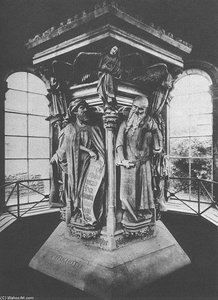
Each prophet and king embodies a specific Old Testament figure foreshadowing Christ’s sacrifice—a concept central to Christian theology and powerfully conveyed through the sculpture’s spatial arrangement and expressive gestures.

Key works · Top 100 works · Claus Sluter reproductions

18/ 34

Jacopo di Cione

Italian b. Florence Gothic Wikipedia 7/32

Jacopo di Cione

Jacopo's dedication extended beyond commissions; he actively participated in shaping Florence’s cultural landscape through his involvement with the cathedral workshop and his role as consul of the Arte dei Medici e Speziali (1384, 1387, 1392).

Key works · Top 100 works · Jacopo di Cione reproductions

19/ 34

Jaume Huguet

Catalan b. Valls Late Gothic, Flemish influence Wikipedia 10/32

Jaume Huguet

Between 1440 and 1445, his hand reached into the workshops of Zaragoza and Tarragona, where he encountered the influential Flemish style brought by Luis Dalmau. His ability to command both scale and detail is evident in his diverse body of work: The Archangel St Michael: A celestial sentinel rendered with heroic posture, framed by stylized foliage and a radiant, textured gold leaf that seems to emanate an inner light.

Key works · Top 100 works · Jaume Huguet reproductions

21/ 34

Master Bertram

German b. Minden International Gothic Wikipedia 13/32

Master Bertram

While sharing similarities with other artists of the period, such as Master Francke (another prominent Hamburg painter), Bertram's work possesses a distinct character—a subtle restraint in emotional expression compared to Francke’s more overtly dramatic approach. The Victoria and Albert Museum in London houses a 45-scene depiction of the Apocalypse, likely created by Bertram's workshop, further demonstrating his influence within the artistic community.

Key works · Top 100 works · Master Bertram reproductions

23/ 34

Paolo Di Giovanni Fei

Italian b. San Quirico d'Orcia Naturalism, Proto-Renaissance Wikipedia 10/32

Paolo Di Giovanni Fei

The Crucifixion, Deposition from the Cross, and Entombment are not merely narrative scenes; they are dynamic compositions filled with emotionally charged figures rendered with remarkable psychological insight. The Nativity of the Virgin (c. 1335-1342), now housed in the Museo dell'Opera del Duomo in Siena, stands as a testament to his mastery of tempera paint and his innovative approach to architectural integration.

Key works · Top 100 works · Paolo Di Giovanni Fei reproductions

24/ 34

Giovannino De' Grassi

Italian b. Milan Gothic Illuminations

Giovannino De' Grassi

Giovannino de’ Grassi remains one of the most captivating enigmas of the late medieval period, a figure whose brushstrokes breathed life into the prestigious Visconti court of Milan. He operated in an era where the transition from the rigid structures of the Middle Ages to the burgeoning naturalism of the early Renaissance was beginning to stir, and de’ Grassim stood at the very heart of this aesthetic evolution.

Key works · Top 100 works · Giovannino De' Grassi reproductions

25/ 34

Lluís Borrassà

Catalan b. Girona International Gothic Wikipedia 8/32

Lluís Borrassà

A pioneer who fundamentally reshaped the visual language of Catalonia, Borrassà emerged from the historic streets of Girona to become a master of the International Gothic style. The foundations of Borrassá’s mastery were laid in his youth, likely under the guidance of his father, Honorat Borrassà, a fellow painter.

Key works · Top 100 works · Lluís Borrassà reproductions

26/ 34

Michele Giambono

Italian b. Venice International Gothic Wikipedia 10/32

Michele Giambono

In the heart of fifteenth-century Venice, a city defined by its shimmering lagoons and unparalleled maritime wealth, the artistry of Michele Giambono emerged as a luminous bridge between the medieval past and the dawning Renaissance. As a follower of luminaries such as Jacobello del Fiore and Gentile da Fabriano, Giambono inherited a fascination with delicate line work and the use of precious materials to evoke the celestial realm.

Key works · Top 100 works · Michele Giambono reproductions

27/ 34

Giovanni dal Ponte

Italian b. Florence Late Gothic/Renaissance Wikipedia 7/32

Giovanni dal Ponte

He also designed numerous triptychs, perhaps most famously his two versions of The Annunciation – one completed in 1430 for Santa Maria in Rosano, the other in 1435 now residing in the Pinacoteca Vaticana.

Key works · Top 100 works · Giovanni dal Ponte reproductions

28/ 34

Theodoric of Prague

Czech b. Italy Gothic Wikipedia 16/32

Theodoric of Prague

His panels often carry a curiously Sienese character, though he avoids the extreme delicacy found in the works of Siena. One such work is Saint Simon, an oil tempera on beech board created around 1360-1365.

Location This space holds the weight of his most significant decorative program.

Key works · Top 100 works

29/ 34

Niccolò di Pietro Gerini

Italian b. Florence Late Gothic Wikipedia 6/32

Niccolò di Pietro Gerini

He is firmly rooted in the school of Giotto di Bondone, inheriting a commitment to expressive figures and a nascent naturalism that broke away from the rigid conventions of Byzantine art.

Key works · Top 100 works · Niccolò di Pietro Gerini reproductions

30/ 34

Pacino di Buonaguida

Italian b. Florence Gothic Art Wikipedia 4/32

Pacino di Buonaguida

His later enrollment in the Arte dei Medici e Speziali around 1330 further solidifies his position as a respected professional, deeply integrated into the city's economic and social fabric.

Key works · Top 100 works · Pacino di Buonaguida reproductions

32/ 34

Jan Baegert

b. Wesel Late Gothic Wikipedia 3/32

Jan Baegert

By 1492, Jan Baegert was recognized as a master in Kalkar, a significant milestone that confirmed his ability to manage large-scale commissions independently. In Hamburg, the Kunsthalle holds two significant examples of his ability to handle specific hagiographic figures: Saint Catherine with a patron and John the Baptist.

Location Tracing the physical remains of Jan Baegert’s output requires looking toward the Westphalian and Lower Rhine regions.

Key works · Top 100 works · Jan Baegert reproductions

33/ 34

Master Of The Osservanza

Italian Late Gothic Wikipedia 8/32

Master Of The Osservanza

These paintings, scattered across museums in Siena, Washington D.C., New York, and Wiesbaden, Germany, offer a profound glimpse into the evolving artistic landscape of late Gothic Italy and reveal a painter deeply attuned to both religious devotion and the complexities of human experience.

Key works · Top 100 works

34/ 34

Master of Heiligenkreuz Abbey

Austrian International Gothic Wikipedia 5/32

Master of Heiligenkreuz Abbey

However, he also incorporated elements of the International Gothic style, characterized by elongated figures, delicate hands, and an expressive use of color. Clare (c. 1400-1410): National Gallery of Art, Washington D.C. – A cornerstone of the Master’s oeuvre, showcasing his dramatic use of light and shadow to convey a sense of profound sorrow and spiritual transcendence.

Key works · Top 100 works

Best-known works

Famous Gothic paintings by artist

  1. Rucellai Madonna by Duccio di Buoninsegna

    Rucellai Madonna

    Duccio di Buoninsegna

    1285 · Galleria degli Uffizi, Florence

  2. Maestà (Madonna with Angels and Saints) by Simone Martini

    Maestà (Madonna with Angels and Saints)

    Simone Martini

    1315 · Palazzo Pubblico, Siena

  3. Adoration of the Magi Altarpiece, left hand predella panel depicting the Nativity by Gentile da Fabriano

    Adoration of the Magi Altarpiece, left hand predella panel depicting the Nativity

    Gentile da Fabriano

    1423 · Galleria degli Uffizi, Florence

  4. Sigismondo Pandolfo Malatesta, Lord of Rimini by Pisanello

    Sigismondo Pandolfo Malatesta, Lord of Rimini

    Pisanello

    1445 · Calouste Gulbenkian Foundation, Lisbon

  5. St. Jerome in His Study by Stefan Lochner

    St. Jerome in His Study

    Stefan Lochner

  6. The Crucifixion with the Virgin and Saint John by Agnolo Gaddi

    The Crucifixion with the Virgin and Saint John

    Agnolo Gaddi

    1380 · Museum of Fine Arts, Boston

  7. Les très riches heures du Duc de Berry: Avril (April) by Limbourg Brothers

    Les très riches heures du Duc de Berry: Avril (April)

    Limbourg Brothers

    1412 · Condé Museum, Chantilly

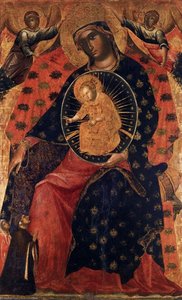
  8. Madonna and Child with two Votaries by Paolo Veneziano

    Madonna and Child with two Votaries

    Paolo Veneziano

    1325 · Gallerie dell'Accademia di Venezia, Venice

Chronology

Gothic chronology

  1. 1188
  2. 1285
  3. 1315
  4. 1336
  5. 1339
  6. 1340
  7. 1340
  8. 1375
  9. 1380
  10. 1387
  11. 1390
  12. 1390
  13. 1394
  14. 1395

Statistics

Counts by country, period and museum

Index

Full list of 34 famous Gothic artists

  1. 1Duccio di BuoninsegnaDuccio di BuoninsegnaItalian · 1255–1319
  2. 2Simone MartiniSimone MartiniItalian · 1284–1344
  3. 3Gentile da FabrianoGentile da FabrianoItalian · 1370–1427
  4. 4PisanelloPisanelloItalian · 1395–1455
  5. 5Stefan LochnerStefan LochnerGerman · 1410–1451
  6. 6Agnolo GaddiAgnolo GaddiItalian · 1350–1396
  7. 7Limbourg BrothersLimbourg BrothersDutch · 1385–1416
  8. 8Paolo VenezianoPaolo VenezianoItalian · 1333–1358
  9. 9Lippo MemmiLippo MemmiItalian · 1291–1356
  10. 10Spinello AretinoSpinello AretinoItalian · 1350–1410
  11. 11Bernardo DaddiBernardo DaddiItalian · 1290–1348
  12. 12Andrea PisanoAndrea PisanoItalian · 1290–1348
  13. 13Master MateoMaster MateoSpanish · 1161–1217
  14. 14Jean MalouelJean MalouelNetherlandish (Dutch) · 1370–1415
  15. 15Tilman RiemenschneiderTilman RiemenschneiderGerman · 1460–1531
  16. 16Master FranckeMaster FranckeDutch · 1380–1435
  17. 17Claus SluterClaus SluterDutch · 1355–1406
  18. 18Jacopo di CioneJacopo di CioneItalian · 1325–1399
  19. 19Jaume HuguetJaume HuguetCatalan · 1445–1492
  20. 20Lucas MoserLucas MoserGerman · 1390–1443
  21. 21Master BertramMaster BertramGerman · 1345–1415
  22. 22Pere SerraPere SerraSpanish · 1357–1406
  23. 23Paolo Di Giovanni FeiPaolo Di Giovanni FeiItalian · 1345–1411
  24. 24Giovannino De' GrassiGiovannino De' GrassiItalian · 1350–1398
  25. 25Lluís BorrassàLluís BorrassàCatalan · 1360–1425
  26. 26Michele GiambonoMichele GiambonoItalian · 1400–1462
  27. 27Giovanni dal PonteGiovanni dal PonteItalian · 1385–1438
  28. 28Theodoric of PragueTheodoric of PragueCzech ·
  29. 29Niccolò di Pietro GeriniNiccolò di Pietro GeriniItalian · 1368–1415
  30. 30Pacino di BuonaguidaPacino di BuonaguidaItalian · 1280–1340
  31. 31Master Of The Life Of The VirginMaster Of The Life Of The VirginGerman ·
  32. 32Jan BaegertJan Baegert1465–1535
  33. 33Master Of The OsservanzaMaster Of The OsservanzaItalian ·
  34. 34Master of Heiligenkreuz AbbeyMaster of Heiligenkreuz AbbeyAustrian ·

FAQ

Gothic: quick answers

Guides

AllPaintingsStore.com guides

Other lists

Famous artists by movement

By period

Famous artists by period

Famous paintings

Famous paintings by movement

Related lists

Related rankings